
Individual & Couples Support in person in Halifax, N.S.
Online across certain parts of Canada*
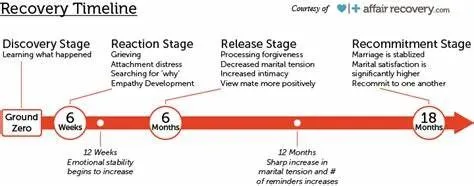
Healing after infidelity and betrayal takes time. While every couple’s recovery is different, rebuilding trust, emotional safety, and connection is often a gradual process that unfolds over many months. The timeline below, developed by Affair Recovery, illustrates some of the stages couples may experience as they work toward healing and rebuilding their relationship.
As a Certified Couples Infidelity Repair Specialist and Registered Marriage and Family Therapist (RMFT), I work with couples and individuals navigating the complex aftermath of infidelity and betrayal. This may include working toward reconciliation and rebuilding the relationship, discerning whether to stay together, navigating separation, or healing individually after the relationship has ended.
My work is also informed by continuing education in betrayal trauma and complex grief, and I am a Certified Grief Support Counsellor. Infidelity can involve profound grief—not only for the relationship as it was, but for the trust, emotional safety, shared story, and understanding of your partner that may suddenly feel shaken or changed.
One of the most confusing parts of betrayal can be that the person you would normally turn to for comfort and reassurance may also be the person who has caused the hurt. This can leave you caught between wanting connection and needing protection while trying to make sense of what has happened.
Healing does not look the same for everyone. Whether the path forward involves rebuilding together, determining what you want for the relationship, separating with greater clarity, or healing on your own, therapy can provide a structured space to begin working through what comes next.
Infidelity can take many forms:
The impact is can create:
If this sounds like areas your experiencing reach out today. I am a neutural party that does not place blame or shame on anyone and works with couples to repair if they so choose to repair after infidelity.
Infidelity is complex. There is no one-size-fits-all explanation, and no two couples experience it the same way. My role is to help you:
You deserve support as you move through this transition. Reach out today to begin your healing journey.
Infidelity can affect both partners in very different ways. Counselling can provide space for the betrayed partner, the partner who engaged in the infidelity, or both partners together to understand what has happened and begin determining what comes next.
For the partner who has experienced betrayal, counselling may explore triggers and emotional overwhelm, rumination and circular thinking, grief, anger, shame, changes in self-esteem and self-worth, loss of emotional safety, difficulty trusting your own judgment, boundaries, unanswered questions, and rebuilding a sense of stability.
For the partner who engaged in the infidelity, counselling may explore shame and guilt, accountability, attachment patterns and anxieties, boundaries, self-esteem and validation, emotional avoidance, relationship patterns, and the personal and relational factors that may have contributed to vulnerability to infidelity. The goal is not to excuse the behaviour, but to develop greater understanding, take responsibility for choices, and identify changes needed to reduce the likelihood of repeating harmful patterns.
For couples choosing to explore reconciliation, therapy may focus on stabilization, understanding the impact of the betrayal, accountability, rebuilding emotional safety and trust, communication, addressing relationship patterns, responding to triggers, and gradually working toward repair and reconnection.
For some people, the path forward may instead involve discernment, separation, or individual healing. Therapy can provide space to explore these decisions without assuming that reconciliation is the right outcome for every relationship.
If you are feeling overwhelmed, stuck, or unsure what comes next after infidelity, you do not have to navigate the aftermath alone. Counselling can provide a supportive space to understand what happened, work through difficult emotions, rebuild a sense of safety and clarity, and begin determining what you need moving forward.
Whether you are the partner who experienced the betrayal, the partner who engaged in the infidelity, or you are seeking support together as a couple, there is no single path forward after infidelity. For some couples, the path involves reconciliation and rebuilding trust. For others, it may involve discernment, separation, or individual healing.